← Back to Pompeii Tickets home
The dionysiac fresco cycle at the Villa of the Mysteries at Pompeii, painted in deep Pompeian red with near-life-size figures

What to See at Pompeii — The Houses, Streets and Frescoes That Define the Visit

The Forum, the Villa of the Mysteries, the House of the Faun, the amphitheatre — and three corners most visitors miss.

Updated May 2026 · Pompeii Tickets Concierge Team

Pompeii is too big to see completely in one day and structured loosely enough that first-time visitors can wander for hours without quite finding the headline rooms. The site is 66 hectares of grid, with the most important houses scattered across roughly two square kilometres of paved streets. This guide is the concierge's honest highlight route: the Forum and the central insulae, the suburban villas, the eastern amphitheatre zone, and three under-visited corners that reward the patient walker. Read it before you arrive, mark the houses that matter to you, and plan a route — Pompeii rewards a half-hour of preparation more than almost any other major heritage site.

The Forum and the Central Insulae

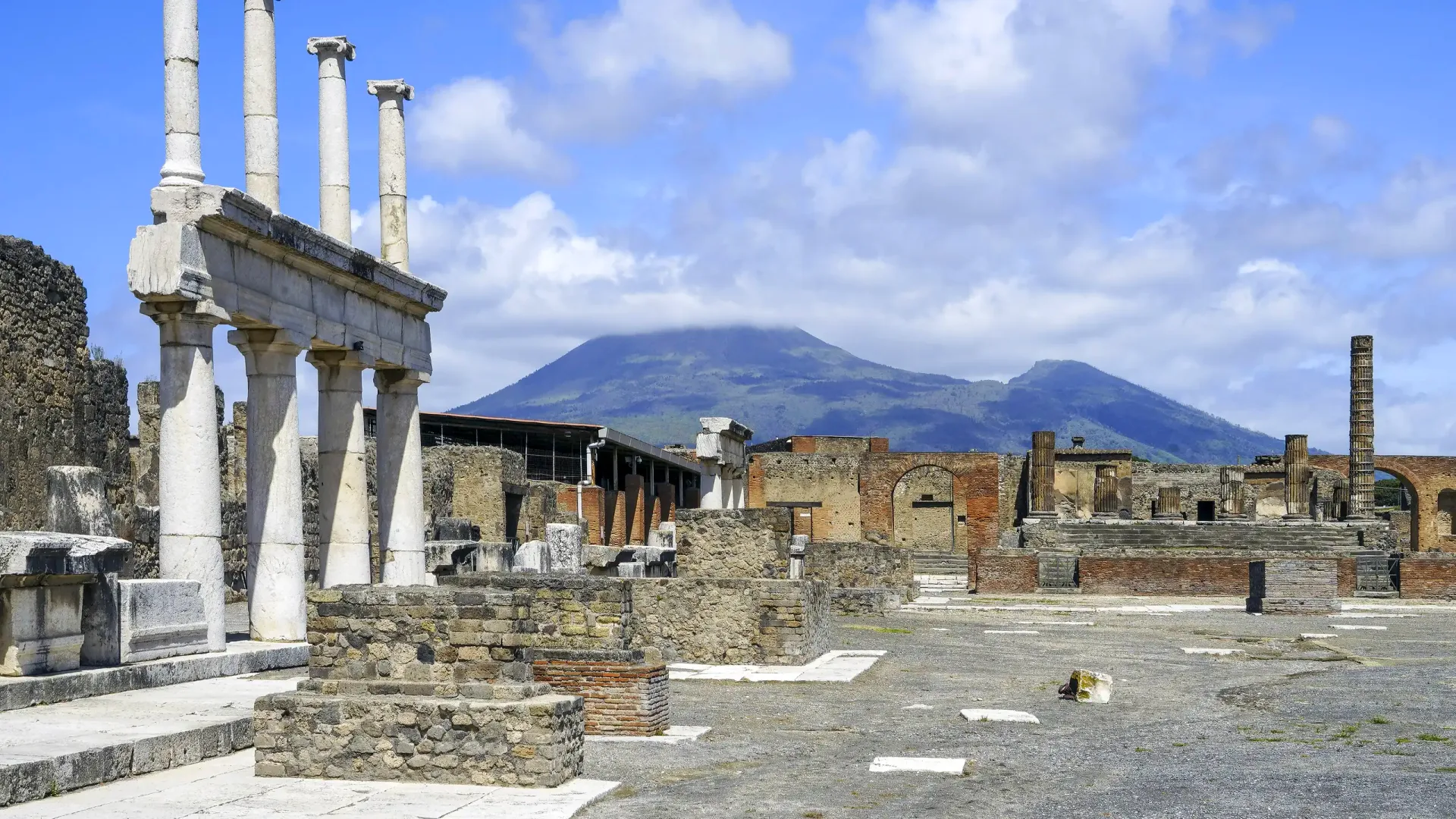
The Forum is the natural starting point and lies a few minutes' walk from the Porta Marina entrance. It is a long rectangular public square enclosed by colonnades, with the Temple of Jupiter at the northern end and Vesuvius rising directly behind — the canonical Pompeii photograph. The Forum was the civic, religious and commercial heart of the city, and the buildings around it carry that range: the Basilica (law courts and commerce), the Macellum (covered market), the Temple of Apollo, and the Eumachia Building (probably a wool-merchants' hall). The Granai del Foro storeroom along the western side displays a number of the plaster body casts of eruption victims — the emotional core of any Pompeii visit and visible from the colonnade through metal grilles. Allow forty minutes for the Forum on a first walk.

From the Forum, head north and east into the central insulae for the headline houses. The House of the Faun is unmissable — at over 3,000 square metres it was the largest private residence in Pompeii, with a small bronze dancing faun in the impluvium (a copy; the original is in Naples) and the replica Alexander Mosaic in situ on the floor of the rear exedra. The House of the Vettii, recently reopened after a long restoration, contains some of the finest erotic and mythological wall painting anywhere in the Roman world — small panels of cupids at work, mythological scenes in the reception rooms, and the famous Priapus figure at the entrance. The House of the Tragic Poet is smaller but iconic for its 'cave canem' (beware of the dog) mosaic at the threshold and its mythological frescoes inspired by Greek tragedy.

Between the major houses, walk the streets themselves. The basalt blocks of Via di Mercurio and Via della Fortuna carry deep cart ruts worn by Roman traffic before the eruption. The fountains at street corners — each fed by the public water system, each carved with a distinct relief used by illiterate citizens to identify their neighbourhood — are working features of the urban grid still in their original positions. Bakeries with their volcanic millstones, fullonicae (laundries) with their washing vats, and shopfronts with their stone counters all read directly to a modern visitor. The central insulae are also where the Lupanare sits — the small two-storey brothel whose explicit wall paintings functioned as a menu — and where queues are heaviest. Visit it early in the 09:00 slot or accept a short wait.

The Villa of the Mysteries (Plus and Great Pompeii Only)

The Villa of the Mysteries (Villa dei Misteri) is the single most important fresco room in the Roman world still in its original setting, and access requires a Plus or Great Pompeii ticket. It lies a short walk north-west of the Porta Ercolano exit along a quiet country lane, well outside the main excavated grid. The villa is large and partly restored, with peristyle gardens and a sequence of dining rooms, but the destination is the Triclinium of the Mysteries — a single rectangular room whose walls carry a continuous painted cycle at near-life-size scale, depicting a young woman's initiation into the cult of Dionysus.

The frieze runs unbroken around three walls, set against a deep Pompeian red ground, with figures rendered in confident classical line and modelled volume. The cycle's interpretation is debated — initiation rite, marriage allegory, mystery-religion sacrament — but its visual power is direct: the colour saturation, the seated matron at the climactic scene, the kneeling figure being whipped, the satyrs and the dancing maenads. Lighting inside the room is deliberately kept low to protect the pigment; eyes need a minute to adjust. Photography is permitted handheld, without tripods or flash.

Allow thirty to sixty minutes for an unhurried visit to the villa as a whole, with at least fifteen minutes in the Mysteries room itself. The villa is one of the first features to close in bad weather; check on the day. The walk back into the main grid via the Porta Ercolano gives an additional bonus: the Street of Tombs (Via dei Sepolcri) outside the gate, lined with elaborately carved Roman funerary monuments — a quiet, evocative half-kilometre that almost no day-tripper sees because it falls outside the central circuit. The Villa of Diomedes sits on this same lane and is included in the Plus ticket.

The Eastern Half — Via dell'Abbondanza to the Amphitheatre

From the Forum, Via dell'Abbondanza runs east through the heart of the residential and commercial city, cutting through nearly a kilometre of insulae before reaching the amphitheatre at the eastern boundary. The walk is long, largely unshaded, and richest for visitors with energy for it. Houses along the way include the House of the Cryptoporticus (with its underground vaulted corridor and gladiator graffiti), the House of Octavius Quartio (with its elaborate water-channel garden), and the Praedia di Giulia Felice — a large, beautifully preserved villa with extensive gardens and a private bath suite that the original owner rented out commercially.

At the eastern end, the Amphitheatre is the oldest surviving stone amphitheatre in the Roman world, built around 70 BC, with a seating capacity of around 20,000 — more than the entire pre-eruption population of Pompeii. It hosted gladiatorial games and the notorious riot of AD 59 between Pompeians and visitors from nearby Nuceria, which led to a senate ban on games at Pompeii for ten years. The structure is largely intact and walkable; the sense of scale from the upper tiers, looking back west across the city to Vesuvius, is the closing image many visitors carry home.

Adjacent to the Amphitheatre, the Great Palaestra is a vast colonnaded sports ground with a central swimming pool — the recreational space of the Pompeian youth and a reminder that this was a leisured, prosperous Roman city, not a frontier outpost. The Palaestra is fully exposed to the sun and should be visited earlier rather than later on hot days. The walk back west via Via di Nola gives a different street character — more domestic, less commercial — and passes the Garden of the Fugitives, an enclosed garden where plaster casts of thirteen citizens lie in the position they died, huddled together against the pyroclastic surge.

Three Corners Most Visitors Miss

The Stabian Baths complex on Via Stabiana is the oldest thermal bath suite in Pompeii and one of the best-preserved Roman baths anywhere. The stuccoed ceilings of the apodyterium (changing room) and the men's caldarium (hot bath) survive in extraordinary detail — coffered, painted, and complete with carved relief decoration showing telamon figures supporting the architectural frame. Most visitors walk past the entrance because the building looks unassuming from the street; inside, it is the single best Roman interior at Pompeii for understanding what daily life felt like under the eruption layer. Allow twenty minutes.

The Temple of Isis sits just behind the Large Theatre in a quiet corner of the southern quarter. It is small — barely a courtyard with a central altar and a raised cella — but it is an exquisite Egyptian-rite sanctuary, beautifully preserved, with painted walls and a complete sacred-water system. The temple was the first major Pompeii structure encountered by 18th-century excavators and influenced the European Romantic imagination of Egypt — Mozart's Magic Flute carries echoes of its iconography. Almost no day-tripper finds it because it does not appear on most fold-out tourist maps. Twenty minutes here is twenty minutes well spent.

The Garden of the Fugitives at the eastern end of the city, in the lee of the Amphitheatre, holds the most direct human encounter at Pompeii. Thirteen plaster casts of eruption victims — adults and children, recovered in 1961 in the position they died — lie in a glass-fronted enclosure within a reconstructed Roman garden. Unlike the casts at the Granai del Foro, which are displayed behind grilles in a storeroom context, the Garden of the Fugitives places them where they were found, in a vineyard, attempting escape. It is quiet, sobering, and the natural emotional resting point at the end of a long walk east. Visitors who skip the eastern half of the city for time miss this corner, and the miss matters.

A Suggested Route by Time Available

If you have three hours: enter at Porta Marina, walk the Forum and the Granai del Foro (body casts), continue north to the House of the Faun and the House of the Vettii, return south via the Lupanare, exit at Porta Marina. This is the central insulae headline route; it covers the photographs most visitors want and skips the eastern walk. It works on an Express ticket and is the right plan for cruise-day-trippers and Rome-based travellers on a tight return schedule.

If you have five hours: add Via dell'Abbondanza east to the Amphitheatre and the Great Palaestra, with a stop at the Garden of the Fugitives on the way back. This is the full headline circuit and uses most of an Express-ticket day. Lunch can be taken inside the park at one of the on-site cafeterias near the Forum or as a picnic in a shaded corner. Plan to leave the eastern walk for early in the day when energy is high and the sun is lower.

If you have a full day and a Plus or Great Pompeii ticket: add the Villa of the Mysteries and the Villa of Diomedes via the Porta Ercolano gate, and consider Boscoreale (Villa Regina and the Antiquarium) as a shuttle-supported afternoon. This is a six-to-eight-hour day and pushes the practical limit of a single Pompeii visit. For visitors with a Great Pompeii three-day pass, day one is the city plus the suburban villas; days two and three carry Oplontis, Stabia and the Antiquarium di Stabia. Sequencing across the pass is the subject of its own guide.

Frequently asked

What is the single most important thing to see at Pompeii?

The Forum with Vesuvius behind it is the canonical view; the Villa of the Mysteries fresco cycle is the most important artwork; the plaster body casts at the Granai del Foro and the Garden of the Fugitives are the most direct emotional encounter. If you can only see one thing, the Forum sets the scene; if you can see two, add the Villa of the Mysteries with a Plus ticket.

Can I see the House of the Vettii?

Yes — the House of the Vettii reopened after a long restoration and is currently accessible on standard Pompeii tickets. It contains some of the finest erotic and mythological wall painting in the Roman world. Confirm current open-status on pompeiisites.org within a fortnight of your visit, as occasional short closures for conservation do occur.

Is the Villa of the Mysteries included in the basic ticket?

No. The Villa of the Mysteries sits outside the main city walls and is included only in the Plus or Great Pompeii ticket tiers. If the Villa of the Mysteries fresco cycle is a priority for your visit, upgrade to Plus at booking — accessing it on an Express ticket is not permitted at the gate.

How long does the full headline circuit take?

Five to six hours for the central insulae, Via dell'Abbondanza to the amphitheatre, the eastern walk back, and time at the suburban villas if you hold a Plus ticket. Allow eight to ten kilometres of walking on uneven basalt streets. A focused central-only visit can be done in three hours.

What is the Lupanare and is it worth visiting?

The Lupanare is a small two-storey building that functioned as Pompeii's purpose-built brothel, with stone beds in cubicles on the upper floor and a series of explicit wall paintings above each door functioning as a visual menu. It is one of the most-visited rooms in the city — queues can form — and it is worth seeing for what it shows about the bureaucratic organisation of Roman daily life. Visit early in the 09:00 slot to avoid the wait.

Where are the body casts displayed?

In two main locations within the park. The Granai del Foro storeroom along the western side of the Forum holds the largest grouped display, visible through metal grilles. The Garden of the Fugitives at the eastern end of the city holds thirteen casts in situ in the position they died. Additional casts appear in the Antiquarium near Porta Marina. Confirm current display locations on pompeiisites.org as casts occasionally move between conservation and exhibition.

What is the oldest building in Pompeii?

The Amphitheatre, built around 70 BC, is the oldest surviving stone amphitheatre in the Roman world. Within the city itself, the Temple of Apollo and parts of the Doric Temple near the Triangular Forum date from the 6th century BC, predating Roman control of the city — these are the deepest historical layers visible to a modern visitor.

What can I see for free or skip without regret?

The Necropolis outside Porta Nocera is fully outside the ticket gate and free to walk through — a worthwhile diversion for visitors interested in Roman funerary practice. Inside the gate, the small houses along Vicolo Storto and Vicolo del Lupanare are repetitive enough that visitors short on time can skip them without regret in favour of the headline houses and the suburban villas.

Are there guided tours available?

Yes — licensed regional Campania guides operate from the main entrance areas including Porta Marina. Always ask to see the regional guide licence card. Prices and availability vary; the concierge can pre-book a vetted licensed guide on request, which removes the gate-side uncertainty and ensures English (or other language) competence.

What should I bring for the walk?

Closed-toe walking shoes (sandals are an injury risk on basalt cart ruts), a refillable water bottle (potable fountains across the site), a brimmed hat and high-SPF sunscreen from April through October, and a light long-sleeved layer for cooler fresco interiors. A small daypack is fine; large luggage must be left at the free cloakroom near each main entrance.